

Research Library
The Medical Science Behind Dioxin & Its Health Consequences
The Research Behind the Hidden Legacy of Agent Orange
A curated index of peer-reviewed studies, government reports, and longitudinal research documenting the health effects of TCDD dioxin — in exposed veterans, their children, and the generations that follow. All citations are drawn from published, publicly accessible sources.
50+
Years of Research
278K+
Seveso Participants
3
Generations Documented
17+
VA Presumptive Conditions
How to Use This Library
Each section covers a distinct area of dioxin research. Studies marked [LANDMARK] represent foundational science that has shaped policy. Studies marked [TRANSGENERATIONAL] document health effects in individuals with NO DIRECT dioxin exposure — the scientific heart of the inherited wounds issue. All PubMed IDs (PMID) and DOIs are provided for physician and researcher access.
Table of Contents
SECTION 01 - Classification, Carcinogenicity & Fundamental Science
SECTION 02- The Seveso Cohort — The Gold Standard of Human Dioxin Research
SECTION 03 - Epigenetic Inheritance — How Dioxin Passes Through Generations
SECTION 04 -Vietnam Veteran Studies — Direct Exposure Health Outcomes
SECTION 05 -Second Generation — Children of Exposed Veterans
SECTION 06 -Third Generation — Grandchildren & Emerging Human Evidence
SECTION 07 -Neurology & Neuropathy — The Nervous System Consequences of Dioxin
SECTION 08 - Reproductive Health — Fertility, Hormonal & Estrogen-Pathway Effects
SECTION 09- Cancer Research — TCDD as a Human Carcinogen
SECTION 10 -Government Reports & Major Institutional Reviews
SECTION 11 -How to Access These Studies — Free Research Resources
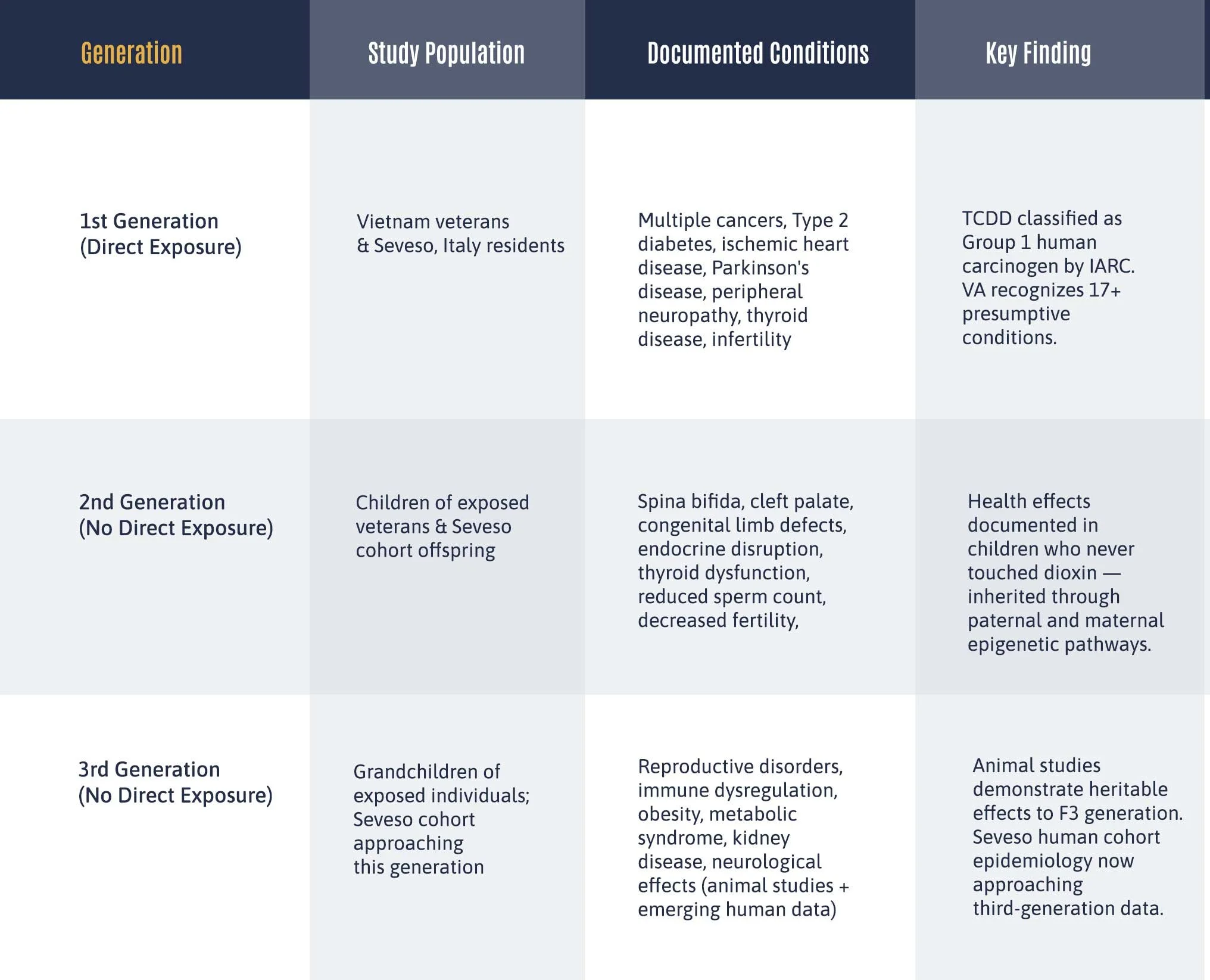
Three Generations of Documented Health Consequences
Classification, Carcinogenicity & Fundamental Science
The foundational body of research classifying TCDD as a human carcinogen and establishing its basic toxicological mechanisms — including aryl hydrocarbon receptor (AhR) activation, persistent organic pollutant behavior, and endocrine disruption.
-
International Agency for Research on Cancer (IARC)
IARC Monographs, Volume 69. Lyon: IARC; 1997.
The definitive international classification of TCDD as a Group 1 confirmed human carcinogen — the highest classification possible. This report synthesized all available epidemiological and experimental data and concluded that dioxin causes cancer in humans. This classification underpins VA recognition of cancer-related presumptive conditions for Vietnam veterans.
[Carcinogenicity] [TCDD] [Policy Foundation]
-
World Health Organization
WHO Fact Sheet. Updated 2016. who.int
Comprehensive WHO review documenting TCDD as a persistent environmental contaminant that accumulates in fatty tissues. Establishes that dioxin has a half-life of 7–11 years in the human body, explaining why Vietnam veteran health effects have continued to manifest and worsen for decades after the war.
-
Mimura J, Fujii-Kuriyama Y.
Biochemical and Biophysical Research Communications. 2003;338(1):311–317. PMID: 14732894.
Describes how TCDD binds to the aryl hydrocarbon receptor (AhR) — a transcription factor present throughout the body — and dysregulates the expression of hundreds of downstream genes. This AhR activation pathway is the primary mechanism by which dioxin causes cancer, immune dysfunction, neurological damage, and endocrine disruption.

-
Pesatori AC, Consonni D, Bachetti S, et al.
Environment International. 2018;121:71–84. PMC6221983.
The definitive 40-year retrospective on the Seveso cohort. Confirms TCDD as a human carcinogen, documents dose-dependent cancer risks across multiple organ systems. Essential reference for understanding dioxin's long-term consequences in the most precisely characterized human exposure cohort.
[Seveso Cohort] [Cancer] [40-Year Follow-Up]
-
di Domenico A, Silano V, Viviano G, Zapponi G.
Toxicology and Applied Pharmacology. 1979. [Seveso series, multiple papers]
The papers establishing the first-ever quantifiable human serum dioxin measurements, collected from Seveso residents following the 1976 accident. These measurements — unique in the history of environmental science — enabled all subsequent dose-response analyses of the Seveso cohort.
-
Bertazzi PA, Consonni D, Bachetti S, et al.
American Journal of Epidemiology. 2008;167(7):847–858. PMID: 18234750.
Twenty-five year mortality analysis of 278,000+ Seveso residents. Documents significantly elevated mortality from cancers of multiple sites in the highest-exposure zones. Identifies dose-dependent patterns: the higher the original TCDD serum level, the higher the subsequent cancer mortality.
-
Eskenazi B, Warner M, et al. (Seveso Second Generation Health Study)
Environmental Health Perspectives. Multiple publications 2014–2021.
Babies born to mothers exposed at Seveso — 30 years after the original exposure — are 6.6 times more likely to have altered thyroid function compared to unexposed controls. These children received no direct dioxin exposure. This finding demonstrates that maternal TCDD exposure durably reprograms thyroid regulation across generations through epigenetic mechanisms.
[Thyroid] [No Direct Exposure] [Second Generation] [6.6x Risk]
-
Eskenazi B, Mocarelli P, Warner M, et al.
Environmental Health Perspectives. 2003;111(6):947–952. PMID: 12760831.
Sons of Seveso-exposed women showed significantly reduced sperm counts — described by the researchers as 'the most pronounced evidence to date that prenatal exposure to an environmental chemical causes low sperm count in offspring with no direct exposure.' Sons did not personally encounter dioxin; their reduced fertility was inherited.
[Male Fertility] [Sperm Count] [No Direct Exposure]
-
Warner M, Eskenazi B, et al. (Seveso Second Generation Health Study)
Environmental Health Perspectives. 446-woman Seveso cohort subset.
Each 10-fold increase in maternal TCDD exposure was associated with a 25% longer time to pregnancy and a 2-times greater likelihood of infertility in daughters born after the exposure. These daughters had no personal dioxin exposure — the fertility impairment was inherited through epigenetic programming.
-
Warner M, Mocarelli P, Brambilla P, et al.
Environmental Health Perspectives. 2014; 611-child cohort. Second Generation Study.
In 611 children of Seveso-exposed parents, prenatal TCDD exposure was associated with increased metabolic syndrome risk in sons and altered insulin resistance in daughters — sex-specific effects documented with no direct dioxin exposure in the children. A 2018 sub-study also confirmed elevated rates of allergic disease and asthma.
-
Mocarelli P, Gerthoux PM, Ferrari E, et al.
The Lancet. 2000;355(9218):1858–1863. PMID: 10866445.
Men who were boys at the time of the Seveso accident later fathered significantly more daughters than sons, with the sex ratio shifting more dramatically the higher the original exposure. This suggests TCDD affects sex determination at the cellular level through effects on sperm.
The Seveso Cohort — The Gold Standard of Human Dioxin Research
On July 10, 1976, a reactor explosion at the ICMESA plant near Seveso, Italy exposed 278,000+ residents to the highest levels of TCDD ever recorded in a civilian population. Uniquely, baseline blood samples were taken at the time of exposure — creating the world's only cohort with known individual dioxin body burden. The cohort has been followed for nearly 50 years.
Why Seveso Is Unique in All of Science
The Seveso population is the ONLY dioxin-exposed human cohort for whom baseline blood TCDD levels were measured at the time of exposure. This enables individual dose-response analysis impossible in any other population, including Vietnam veterans. Every subsequent generation of Seveso offspring can be analyzed against precise parental exposure data — making this cohort the most powerful available tool for understanding transgenerational dioxin consequences in humans.
Epigenetic Inheritance
How Dioxin Passes Through Generations
⚠️ The Scientific Heart of This Issue
The studies in this section document health effects in individuals who were NEVER exposed to dioxin. The damage was transmitted through inherited changes to gene expression — called epigenetic modifications — in sperm and eggs. This is not theoretical. It has been documented in peer-reviewed journals at major research institutions and replicated across multiple independent laboratories.
-
Manikkam M, Tracey R, Guerrero-Bosagna C, Skinner MK.
PLOS ONE. 2012;7(9):e46249. DOI: 10.1371/journal.pone.0046249.
The landmark paper demonstrating that TCDD produces epigenetically inherited disease across three generations in rats. Gestational exposure produced elevated disease rates not only in directly-exposed rats (F1) but in their children (F2) and grandchildren (F3) — with no further dioxin exposure in any generation. This study is foundational to all subsequent transgenerational dioxin research.
[Transgenerational] [F3 Generation] [Sperm Epimutations] [Skinner Lab]
-
Published in Environmental Epigenetics.
Environmental Epigenetics. 2024. [Vietnam veteran sperm epigenome study]
A 2024 study identified 437 epigenetically modified genes in the sperm of Vietnam veterans with documented dioxin exposure, distinct from unexposed control individuals. These modifications represent the biological mechanism by which exposure is transmitted to offspring — directly linking the veteran's war service to the health of the next generation.
-
Skinner MK, Manikkam M, Guerrero-Bosagna C.
Trends in Endocrinology & Metabolism. 2010;21(4):214–222. PMID: 20074966.
Review paper by Michael Skinner's Washington State University laboratory summarizing the epigenetic transgenerational mechanism across multiple environmental toxicants. Establishes that germline epigenetic reprogramming is the primary biological pathway through which parental environmental exposures produce disease in unexposed offspring.
Vietnam Veteran Studies
Direct Exposure Health Outcomes
Research specifically studying the approximately 2.7 million U.S. service members who were exposed to Agent Orange / TCDD during the Vietnam War, documenting the range and severity of health consequences that have emerged over five decades.
-
U.S. Department of Veterans Affairs, Public Health Service.
VA Public Health. publichealth.va.gov/exposures/agentorange/
The VA's official exposure data: an estimated 2.7 million U.S. veterans were exposed to Agent Orange during the Vietnam War. The VA maintains the Agent Orange Registry, benefits program, and ongoing research. Helicopter pilots and crew members are noted among the highest-exposure groups due to repeated flight through and above sprayed areas.
-
Multiple authors; VA-sponsored research. Compiled in VAO Update 11.
Neurology and Environmental Health Perspectives, 2006–2024. National Academies VAO Update 11.
Multiple studies document that Vietnam veterans with confirmed Agent Orange exposure have a 2 to 3 times higher risk of developing Parkinson's disease than the general population. TCDD is believed to damage dopamine-producing neurons in the substantia nigra over time. Parkinson's disease is an official VA presumptive condition.
-
Henriksen GL, Ketchum NS, Michalek JE, Swaby JA.
Epidemiology. 1997;8(3):252–258. PMID: 9115017. (Air Force Health Study — Ranch Hand)
Documents a dose-dependent relationship between serum TCDD levels and risk of Type 2 diabetes. Men in the highest TCDD quartile had significantly elevated diabetes rates compared to lower-exposure controls. Type 2 diabetes is an official VA presumptive condition. This dose-response relationship strengthens the causal interpretation.
-
VA Research and Development; VA PADRECCs.
VA Research publications. 2025.
Within the past year, VA Research published new findings linking Agent Orange exposure to skin cancer risk, expanded Parkinson's findings, and potential new treatment approaches. Represents the continuing expansion of recognized Agent Orange health consequences.
Second Generation
Children of Exposed Veterans
Studies examining the children of Vietnam veterans with Agent Orange exposure, documenting elevated rates of birth defects, developmental disorders, reproductive conditions, and immune dysregulation in individuals with no personal dioxin exposure.
📊 The ProPublica Finding: 30% Higher Birth Defect Rate
A 2016 investigative analysis by ProPublica, examining VA registry data, found a roughly 30 percent higher incidence of birth defects in the children of Vietnam veterans with known Agent Orange exposure compared to those who were unexposed. The VA officially recognizes spina bifida for all Vietnam veterans' children and 18 additional birth defect conditions for daughters' children — acknowledging the generational transmission of harm.
-
U.S. Department of Veterans Affairs.
38 CFR Part 3. VA Benefits Administration. benefits.va.gov.
The VA officially recognizes spina bifida as service-connected for all children of Vietnam veterans, and recognizes 18 additional birth defect conditions for the children born to daughters of Vietnam veterans. This represents the government's formal acknowledgment that Agent Orange exposure transmitted health consequences to children with no personal exposure.
-
Published in Environmental Epigenetics, 2024.
Environmental Epigenetics. 2024.
The most direct human evidence that Vietnam veterans' dioxin exposure altered their reproductive biology: 437 epigenetically modified genes were identified in the sperm of veterans with dioxin exposure, distinct from unexposed controls. These sperm epimutations are the biological mechanism through which paternal exposure is transmitted to children.
-
Multiple authors; review in reproductive toxicology literature.
Environmental Health Perspectives; Reproductive Toxicology. Multiple studies 1993–2024.
Dioxin is among the most strongly studied environmental contributors to endometriosis through AhR pathway activation and estrogenic disruption. Daughters of Vietnam veterans with heavy Agent Orange exposure report significantly elevated rates of endometriosis. The VA acknowledges research connecting TCDD to endometriosis and related reproductive conditions in female offspring.
Third Generation
Grandchildren & Emerging Human Evidence
The frontier of dioxin research. Animal studies demonstrate robust heritable effects through the F3 generation. The Seveso human cohort is approaching this generation of follow-up.
🔭 The Current State of Third-Generation Research
The animal evidence for third-generation effects is strong and consistently replicated across multiple independent laboratories. Human evidence from the Seveso cohort is now approaching this generation. For Vietnam veteran grandchildren, no large-scale human study has yet been conducted — a critical gap the Inherited Wounds Foundation is actively working to close. In 2021, Congress passed the Military Children's Toxic Exposure Research Act requiring VA action. As of 2026, implementation has not occurred.
-
Manikkam M, Tracey R, Guerrero-Bosagna C, Skinner MK.
PLOS ONE. 2012;7(9):e46249. Skinner Laboratory, Washington State University.
Following gestational TCDD exposure in rats (F0), significantly elevated disease rates were observed in the F3 generation — the equivalent of great-grandchildren — with zero further dioxin exposure in any intervening generation. Kidney disease, prostate disease, ovarian disease, and immune disorders were all elevated. The F3 finding rules out any explanation other than germline epigenetic inheritance.
-
Eskenazi B, et al. (Seveso research team, UC Berkeley)
Environmental Health Perspectives. Ongoing study; initial publications expected 2025–2027.
The Seveso cohort is now old enough for the grandchildren of original 1976 exposures to be studied systematically. The Seveso Third Generation Health Study represents the most important near-term source of human evidence for grandchild health effects of dioxin. Its findings will directly inform policy for Vietnam veteran grandchildren.
Neurology & Neuropathy
he Nervous System Consequences of Dioxin
Research documenting TCDD's damage to the central and peripheral nervous systems — from peripheral neuropathy in veterans to Parkinson's disease to neurological effects in offspring. TCDD is a potent neurotoxin acting through AhR-mediated mitochondrial dysfunction, chronic neuroinflammation, and myelin disruption.
-
Regenerative Medicine Educational Series / ADSC Clinical Review.
Agent Orange–Associated Peripheral Neuropathy: Clinical White Paper. 2024.
Synthesizes the TCDD peripheral neuropathy mechanism: AhR activation disrupts axonal transport and Schwann cell function; mitochondrial dysfunction impairs nerve cell energy; chronic neuroinflammation (TNF-α, IL-1β, IL-6) sustains damage; oxidative stress damages dorsal root ganglia. Critically, TCDD establishes a self-perpetuating neuroimmune dysregulation that continues damaging peripheral nerves decades after exposure ends.
-
Multiple VA and academic investigators.
Neurology; Journal of Peripheral Nervous System; VA research reports. Multiple dates.
Multiple studies document significantly elevated rates of both large and small fiber peripheral neuropathy in Agent Orange–exposed veterans compared to non-exposed controls, with manifestations including burning pain, sensory loss, motor weakness, and autonomic dysfunction. Peripheral neuropathy is an official VA presumptive condition.
-
Regenerative Medicine Research.
Regenerative Medicine Educational Series. ADSC clinical review 2024.
Reviews the emerging evidence base for adipose-derived stem cells (ADSCs) and stromal vascular fraction (SVF) as a mechanistically rational treatment for TCDD-induced neuropathy. ADSCs act through paracrine signaling, immune modulation, mitochondrial transfer, and angiogenesis — targeting the underlying biological mechanisms rather than merely masking pain.
Reproductive Health
Fertility, Hormonal & Estrogen-Pathway Effects
TCDD is a potent endocrine disruptor with specific affinity for estrogen signaling pathways. Research on dioxin's effects on reproductive health in directly exposed individuals and — critically — in their children and grandchildren through epigenetic transmission.
-
Multiple investigators. Compendium review.
Environmental Health Perspectives; Reproductive Toxicology. Multiple studies 1990–2024.
TCDD binds to AhR receptors in reproductive tissue and dysregulates estrogen signaling — producing endometrial proliferation and immune disruption of the reproductive system. Daughters of Agent Orange–exposed veterans report significantly elevated rates of endometriosis, PCOS, uterine fibroids, and premature ovarian insufficiency. The AhR/estrogen pathway link explains why daughters are disproportionately affected compared to sons.
-
Seveso Women's Health Study investigators.
Environmental Health Perspectives. Multiple publications 1999–2020.
Documented thyroid hormone disruption persisting for decades in Seveso-exposed women, with subclinical hypothyroidism and Hashimoto's-pattern autoimmune thyroid disease. Thyroid disorders are among the most consistently reported conditions in daughters and granddaughters of Vietnam veterans — reflecting both direct endocrine disruption and inherited epigenetic thyroid programming.
-
Warner M, Mocarelli P, Brambilla P, et al.
Environmental Health Perspectives. 2014; 611 children; Second Generation Study.
In 611 children of Seveso-exposed parents, in utero TCDD was associated with metabolic syndrome in sons and altered glucose metabolism in daughters — with no direct dioxin exposure in the children and distinct sex-specific patterns. Documents that TCDD-derived epigenetic reprogramming affects males and females differently.
Cancer Research
TCDD as a Human Carcinogen
TCDD is classified as a Group 1 human carcinogen by IARC — the highest classification. This section covers cancer-specific research in Vietnam veterans and Seveso cohorts, documenting specific cancer types, dose-response relationships, and lag times.
-
Pesatori AC, Consonni D, Rubagotti M, Grillo P, Bertazzi PA.
Environment International. 2009;35(8):1144–1150. PMID: 19539375.
The definitive cancer mortality analysis of 278,000+ Seveso residents over 40 years. Documents significantly elevated mortality from lymphoma, leukemia, lung cancer, gastrointestinal cancers, and breast cancer in proportion to original TCDD serum levels. Confirms dose-response relationship at real-world environmental exposure levels.
-
National Academies of Sciences / U.S. Department of Veterans Affairs.
Veterans and Agent Orange: Update 11. National Academies Press, 2018.
The VA currently recognizes multiple cancers as Agent Orange presumptive conditions including: prostate cancer, bladder cancer, lung and bronchial cancer, laryngeal cancer, soft tissue sarcomas, non-Hodgkin's lymphoma, Hodgkin's disease, multiple myeloma, chronic B-cell leukemias, and monoclonal gammopathy (MGUS).
-
Eskenazi B, Warner M, Brambilla P, et al.
Environmental Health Perspectives. 2021. Seveso Women's Health Study, 32-year follow-up.
In 32 years of follow-up, a 10-fold increase in serum TCDD was associated with a 2.1-fold greater breast cancer risk in Seveso-exposed women. This dose-response relationship directly informs elevated breast cancer concern in daughters of veterans — whose estrogen pathways may have been epigenetically reprogrammed without direct exposure.
Government Reports & Major Institutional Reviews
-
National Academies of Sciences, Engineering, and Medicine.
Washington, DC: National Academies Press; 2018. FREE at nap.nationalacademies.org and ncbi.nlm.nih.gov/books/NBK356077/
The gold standard reference for Agent Orange health consequences — the 11th in a series of comprehensive reviews commissioned by Congress. Update 11 evaluated the health effects for the nearly 3 million Vietnam-era veterans who may have been exposed to Agent Orange, reviewing hundreds of new studies. The full text is free online. It is the first document any physician caring for a Vietnam veteran or their family should reference.
-
United States Congress. 117th Congress.
Public Law. Enacted 2021. VA implementation status: Pending as of March 2026.
In 2021, Congress passed legislation requiring the VA to develop a research program specifically studying health effects in children of veterans exposed to toxic chemicals, including Agent Orange. As of March 2026, the VA has not implemented this law. This represents the critical gap between scientific consensus and policy action — the gap that the Inherited Wounds Foundation exists to close.
-
U.S. Air Force / Department of Defense.
Multiple publications, 1982–2010. Final summary: Pavuk M et al. PMID: 14552564 and subsequent.
Followed 1,261 Ranch Hand veterans who directly sprayed Agent Orange and 1,452 control veterans for more than 20 years. Produced extensive data on dose-response relationships — documenting elevated rates of Type 2 diabetes, ischemic heart disease, peripheral neuropathy, and multiple cancers in a dose-dependent pattern. The best-documented human dose-response dataset for Agent Orange.
The comprehensive government-commissioned reviews that synthesize all available science and form the basis for VA policy decisions. These reports are freely available online and are the most authoritative sources for presenting evidence to physicians and policymakers.
How to Access These Studies
Free Research Resources
All of the studies cited in this document are available to the public — most at no cost. Share these resources with your physicians so they can review the primary literature directly.
-
Free database of 36 million medical abstracts. Search study authors or titles. Many papers available free through PMC.
pubmed.ncbi.nlm.nih.gov
-
Free access to all Veterans and Agent Orange reports (Updates 1–11). The complete VAO Update 11 is freely available in full.
nap.nationalacademies.org
-
Full text of all National Academies VAO reports. Search 'Veterans and Agent Orange Update 11' for the most recent comprehensive review.
ncbi.nlm.nih.gov/books/NBK356077
-
Primary journal for most Seveso cohort publications. Operated by NIEHS — all content is open access and free.
ehp.niehs.nih.gov
-
Veterans can register for a free health exam, access benefits information, and connect with VA researchers.
publichealth.va.gov/exposures/agentorange
-
Open-access journal hosting the Skinner TCDD transgenerational studies. Full text free — search 'Manikkam TCDD transgenerational' for the key 2012 paper.
journals.plos.org/plosone

Using This Research with Your Physician
When presenting this research to a physician unfamiliar with dioxin's multi-generational effects, we recommend starting with the National Academies VAO Update 11 (free online) and the Seveso Second Generation Health Study publications in Environmental Health Perspectives. These are the most authoritative peer-reviewed sources and are likely to carry the most weight in a clinical conversation. The IWF also provides a Family Health Reference document designed to be shared with healthcare providers.
Inherited Wounds Foundation — Healing the Hidden Legacy of Toxic Exposure
Research Library v1.0 | March 2026 | inheritedwounds.org
DISCLAIMER: This library is for educational and informational purposes only. Nothing in this document constitutes medical advice. The research presented here is intended to inform conversations with qualified healthcare providers, not to replace them. If you or a family member have health concerns related to Agent Orange exposure, please consult a physician.